
Forsyth County Wanted Fugitives
The sheriff posts its picks through the official Forsyth County Most Wanted catalog, a Police-to-Citizen interface. Filters cover first name, last name, age, charge, issued date, race, and gender. Each result card may show a photo. It may also list the agency, the charge or warrant detail, an issued date, and physical characteristics or alerts when those fields are filled in.
Sheriff Ron H. Freeman heads the Forsyth County Sheriff's Office. That office runs the county jail and the current-inmate inquiry. State custody is separate. It falls to the Georgia Department of Corrections. A wanted card is neither a jail booking nor a state offender profile. Keep the three straight.
The catalog is selective, though. FCSO's warrant unit maintains every active warrant and handles confirmation, execution, recalls, extradition, and fugitive investigations. The public catalog only asks for help with chosen cases. It publishes no fixed count and no refresh schedule. Trust what the official page shows when you view it. An old card is just that: old.
Safety first: never approach, follow, detain, or warn someone on a wanted card. Pass what you know to the listed law-enforcement channel. Call 911 if danger is immediate.
To see the sheriff's current cards, use the official Most Wanted catalog. Photos live there, not here.
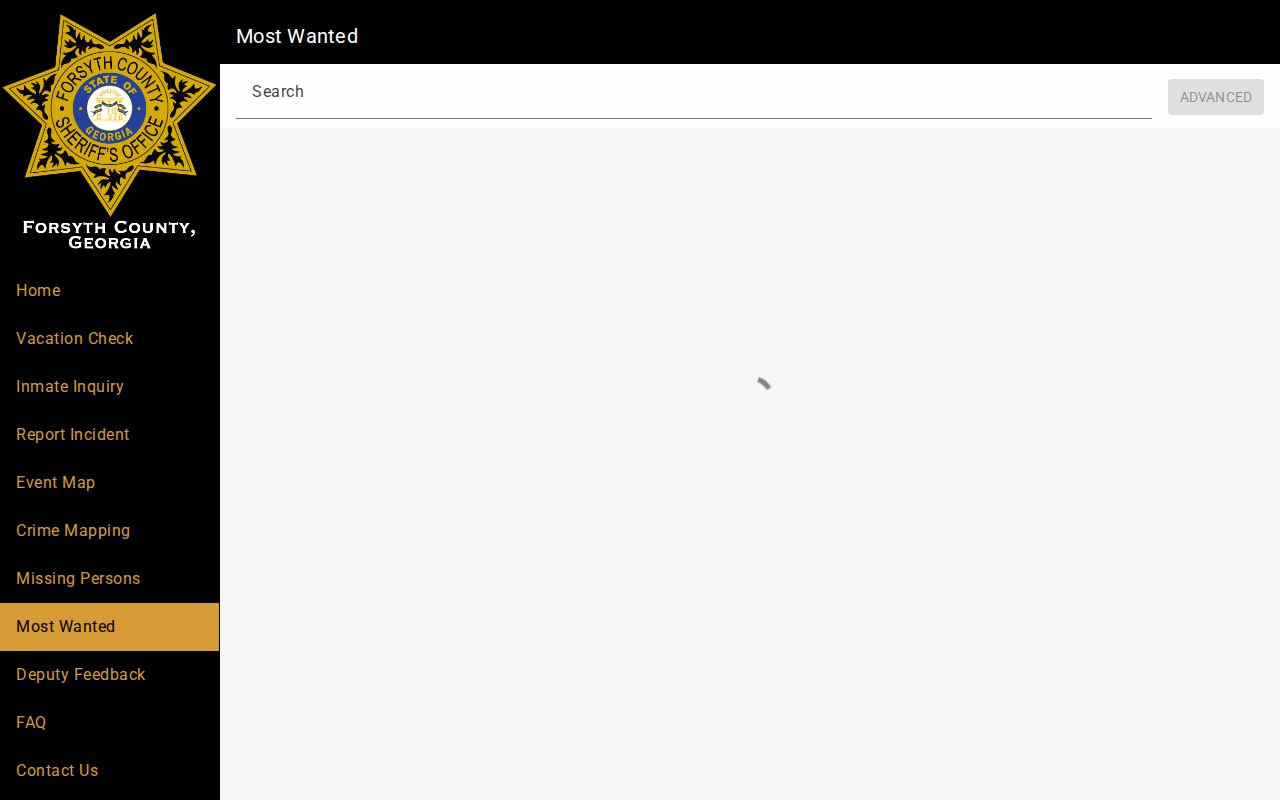
The screenshot simply documents the search surface. It is not a gallery, and it says nothing about a complete warrant count.
Fields on a Wanted Listing
Treat a card as a request for information from law enforcement. Fields can be missing. Details can shift as an investigation develops. Your best check is to line up the name against the agency, the issued-date detail, the charge text, and the physical description. A face that looks familiar is not proof of identity.
| Listing field | What it means |
|---|---|
| Name | The name published by FCSO for the selected wanted entry. |
| Photograph | An image supplied through the official card when available. Keep it on the sheriff's source. |
| Charge or warrant basis | The charge or warrant-related text shown by the agency, not a conviction. |
| Issued date | A date associated with the listed warrant or entry when the card supplies one. |
| Agency | The responsible law-enforcement agency or unit attached to the record. |
| Characteristics or alerts | Physical or safety information included by FCSO when configured for that case. |
A warrant is a court-authorized order or other lawful process. It directs an arrest or search, depending on its type. A wanted card is a public notice about one selected entry. The two are not the same. Someone can have a warrant without ever appearing on a list. A card can also stay online after a status changes behind the scenes.
How to Read Forsyth Wanted Listings
Read the official page. Then hand any safety concern to the agency. Your job is not field investigation. It is to preserve the source, avoid mistaken identity, and let trained personnel decide what action fits.
- Open the FCSO Most Wanted catalog and note the page date or update detail if displayed.
- Search with the available name or detail fields, then compare the agency, charge text, issued date, and description.
- Do not copy the photograph into a new collection or treat a likeness as proof. Keep the official source as the reference.
- Send a tip to the warrant tipline or the listed email. Give facts that can be checked and do not confront the person.
- For a personal record question, speak with counsel or the relevant court and use the county record path described in the Forsyth County booking and records search.
Never treat a third-party page as a live warrant source. Publishers copy cards long after official status changes. A shared name can pin facts on the wrong person. The originating agency and the court settle such questions.
Check a Forsyth County Warrant
No comprehensive public warrant-search portal exists for Forsyth County in these sources. The Most Wanted catalog is searchable but selective. For one specific person, contact the FCSO warrant clerk. Or get legal advice before acting. A court docket can reveal warrant activity, though only the responsible authority can confirm whether a warrant is active, recalled, served, or executable.
- Gather the person's correct full name and any case or court details. Do not rely on a photo or a common-name match.
- Call the FCSO warrant clerk at 770-781-3066, or ask a lawyer to make the inquiry when the concern is personal.
- Use the Forsyth Clerk case-search route for court information, while remembering that an online docket is not the sole live-status confirmation.
- If a warrant concern is your own, ask counsel or the court about a lawful way to address it. Do not hide, flee, or attempt to avoid service.
Call the public warrant line for confirmation. It handles official routing too. It will not predict how an encounter will go. A records request works differently. That may surface a historical warrant document, but it cannot replace current confirmation. Keep everything tied to the right county and court.
FCSO Warrant Contacts
Warrants Clerk: 770-781-3066
Warrants Tipline: 770-781-2206
Email: SOwarrants@forsythco.com
Emergency: 911
The FCSO criminal investigations and warrants information page explains the unit's role and lists the official contact path.
For a status question, the unit page beats a copied wanted card or an old publisher entry every time.
Warrant Types and Status
Warrant wording can confuse anyone. The broad categories here explain why sources look different, though live status always belongs to the court and law-enforcement custodian. A bench warrant, for instance, grows out of a court process, while an arrest warrant stems from probable cause tied to a criminal charge. Cards rarely spell out every procedural step.
| Term | Plain meaning | What to do |
|---|---|---|
| Arrest warrant | Process directing law enforcement to take a person into custody based on the stated legal basis. | Ask the warrant clerk, court, or counsel for current status. |
| Bench warrant | A court-issued process commonly connected to a missed court obligation or order. | Use the court or counsel for a lawful response. |
| Recall | The responsible authority has withdrawn or cancelled the process. | Confirm the recall; do not assume an old card has been removed. |
| Extradition | The process for moving a person across jurisdictions when the legal conditions apply. | Leave the decision and movement to the authorities and counsel. |
| Active or executable | Status language indicating that the responsible authority still treats the process as usable. | Only FCSO or the court can confirm it for a specific person. |
None of these terms settles a case. A warrant can be issued long before any final outcome, so check the court record once the custody question is resolved.
Tips, Rewards, and Safety
Two phone lines and one email address handle tips in Forsyth County. The sheriff's warrant tipline is 770-781-2206, and tips can go to SOwarrants@forsythco.com. Crime Stoppers runs its own number, 770-888-7308, for anonymous tips and offers rewards up to $1,000 when information leads to an arrest under its rules. Which tips qualify, and how anonymity works, is decided by the group that receives the call. No reward is automatic.
When you contact an agency, share what can be checked. A name helps. So do a location, a time, and plain facts about the event. Leave the rest to law enforcement: never approach the person, tip them off, post a location online, or try an arrest yourself. If danger is immediate, call 911. Tips belong with officers, not in a public argument.
Note: A wanted entry reflects a charge and a law-enforcement status, and a dismissal, plea, reduction, or acquittal can change the case later.
Why the List Is Selective
A wanted list and an all-warrant check answer different questions in Forsyth County. The sheriff's unit manages active warrants, executions, recalls, extraditions, and fugitive work. The public cards are a selected set. They exist to invite help. Seeing a face there is useful. Not seeing one proves little, because the catalog only shows who was displayed when you looked.
A county roster answers a different question. It tells you who is in custody right now, not who has a warrant. Plenty of people with warrants are not in jail. After an arrest, a name may appear in the FCSO inmate catalog, though the booking charge and the court outcome still take separate checks. These tools connect through a person's path through the system, not through any promise of matching names.